Gennaro Vessio
Research
What I work on — and a few things I have learned while doing it.
I am deeply fascinated by how machines can be programmed to simulate human intelligence, support domain experts in tackling complex problems, and uncover meaningful patterns within large-scale datasets.
My research interests currently revolve around deep learning, computer vision and multimodal AI. I am particularly interested in methods that remain useful when they leave controlled benchmarks and meet real-world constraints: limited resources, imperfect data, human users, and decisions that need to be understood and trusted.
This has gradually led me toward a broader research direction: efficient and trustworthy AI for real-world systems. I see efficiency and trustworthiness less as isolated topics than as properties that intelligent systems increasingly need in order to be genuinely useful.
My main application domains include e-health, drone vision and autonomous systems, and digital humanities / cultural heritage. Over the years I have also worked on handwriting analysis, biometrics, knowledge graphs, probabilistic models, formal methods and other topics—research careers are rarely straight lines!
Current directions
Efficient AI
I am interested in making modern learning systems less computationally demanding, especially for computer vision and multimodal applications. This includes efficient adaptation, lightweight architectures and deployment in resource-constrained settings such as drones and edge devices.
Trustworthy AI
A model that performs well is not necessarily a model we should trust. My work focuses on specific aspects of trustworthy AI, particularly interpretability and explainability, knowledge-aware learning, and methods designed to make AI systems more transparent and meaningful to domain experts.
Multimodal AI
Many real problems do not come neatly packaged as a single data modality. I am interested in systems that combine images, text, structured knowledge and other signals, with applications ranging from medical decision support to cultural heritage.
A few words about research
Throughout my life, I have undertaken a variety of manual and intellectual jobs, and I have learned that—regardless of the task—excellence comes naturally when you are truly passionate about what you do. Research, however, has proven to be the most challenging endeavour I have ever faced. It is inherently multifaceted and requires a combination of hard and soft skills that can only be developed through continuous growth and learning.
Despite these challenges, research is extraordinarily stimulating. Since embarking on this journey, Mondays have never felt exhausting—perhaps because, in research, you never fully disconnect!
In my humble opinion, to do good research you should:
- ❤️ Be passionate. Without passion, surviving in the academic world is nearly impossible.
- 💪 Work hard and stay enthusiastic. Research can be frustrating, but enthusiasm and persistence matter. Keep working, stay curious, and trust the process: if you put in the effort, sooner or later something good will happen.
- ✂️ Know when to cut. Not every idea, experiment or project deserves to be pursued indefinitely. Learn when to persist, but also when to stop, change direction or let an idea go. Time and attention are among a researcher’s most valuable resources.
- ❓ Embrace doubt and uncertainty. This is where research truly begins; without them, you are not really doing research. Be willing to question not only your own results, but also assumptions that others take for granted.
- 🎯 Choose the right topic. Academia can be highly competitive and is often driven by quantitative metrics such as publications and citations. Working in an active area can increase visibility and opportunities, but do not confuse a hot topic with an important problem. Niche topics can also thrive when they address meaningful questions and are pursued with the right strategy.
- 🌍 Know your community. Become part of the research community around your field: get to know its people, but also its paradigms, benchmarks and venues. Understanding how the community works—and what it considers good research—is essential for positioning and communicating your work effectively.
- 🔭 Question the paradigm. As you gain experience, learn to question established assumptions. Sometimes progress comes not from improving the current approach, but from asking whether we are approaching the problem in the right way at all.
- 👩🔬 Balance intuition and experience. New ideas often begin with intuition, but technically sound experiments and good papers come with experience. Early in your career, work alongside experienced researchers and learn from them. With time, develop the confidence to pursue your own scientific questions.
- 🛠️ Start small. New ideas rarely appear out of nowhere. Replicating a recent study from a strong conference or journal gives you a baseline, helps you understand the state of the art and often reveals open questions. But replication should be a starting point, not the destination.
- 🔗 Tackle open problems. Every research community has challenges that need to be solved to move the state of the art forward. Do not ask only how to improve an existing method; ask which problems are actually worth solving.
- 🧭 Develop a research identity. Individual papers matter, but over time they should begin to form a coherent scientific trajectory. Try to become associated with a recognizable set of questions, ideas or problems rather than a collection of unrelated publications.
- 📚 Choose the right venue. Look at where the authors you cite publish and where the community you want to reach discusses its best work. Above all, avoid predatory journals—one strong paper is far more valuable than many weak ones.
- 👥 Know your audience. Assume a reasonable level of expertise and avoid being unnecessarily didactic. A paper should make its contribution clear without explaining everything from first principles.
- ⏳ Structure your article like an hourglass. Start from the big picture, narrow down to the technical details, then broaden the discussion again in the conclusions.
- ✍️ Write with care. Pay attention to structure, grammar, punctuation, equations, figures and formatting. Good writing is part of good research: if you do not care about presenting your work clearly, why should reviewers care about reading it?
- 🤖 Use AI tools, but do not outsource your thinking. They can accelerate coding, literature exploration, writing and experimentation, but you remain responsible for the scientific reasoning, originality and verification of your work.
- 🚫 Do not overdo self-citations. Cite your previous work when it is genuinely relevant, but be selective and balanced.
- 🙏 Respect reviewers. Peer review is largely voluntary work. Consider feedback carefully, even when you disagree. Reviewers can be wrong, but criticism is still an opportunity to reconsider how clearly and convincingly you have presented your work.
- 🌟 Be humble. Temper enthusiastic claims. Your work matters, but it is one piece of a much larger puzzle. Every result depends on assumptions, evidence and limitations, and remains open to improvement—or even falsification.
A small turning point
I firmly believe that life is shaped by key moments—sometimes driven by unconscious choices—that can significantly alter our path. One such moment for me was receiving the Best Presentation Award at SFLA 2018 from Prof. Giovanna Castellano. The prize? A book on Fuzzy Logic by Lotfi Zadeh, which my pug later found surprisingly delicious!
Looking back, that moment marked the beginning of a new chapter in my academic journey. I still like to think that the best is yet to come!
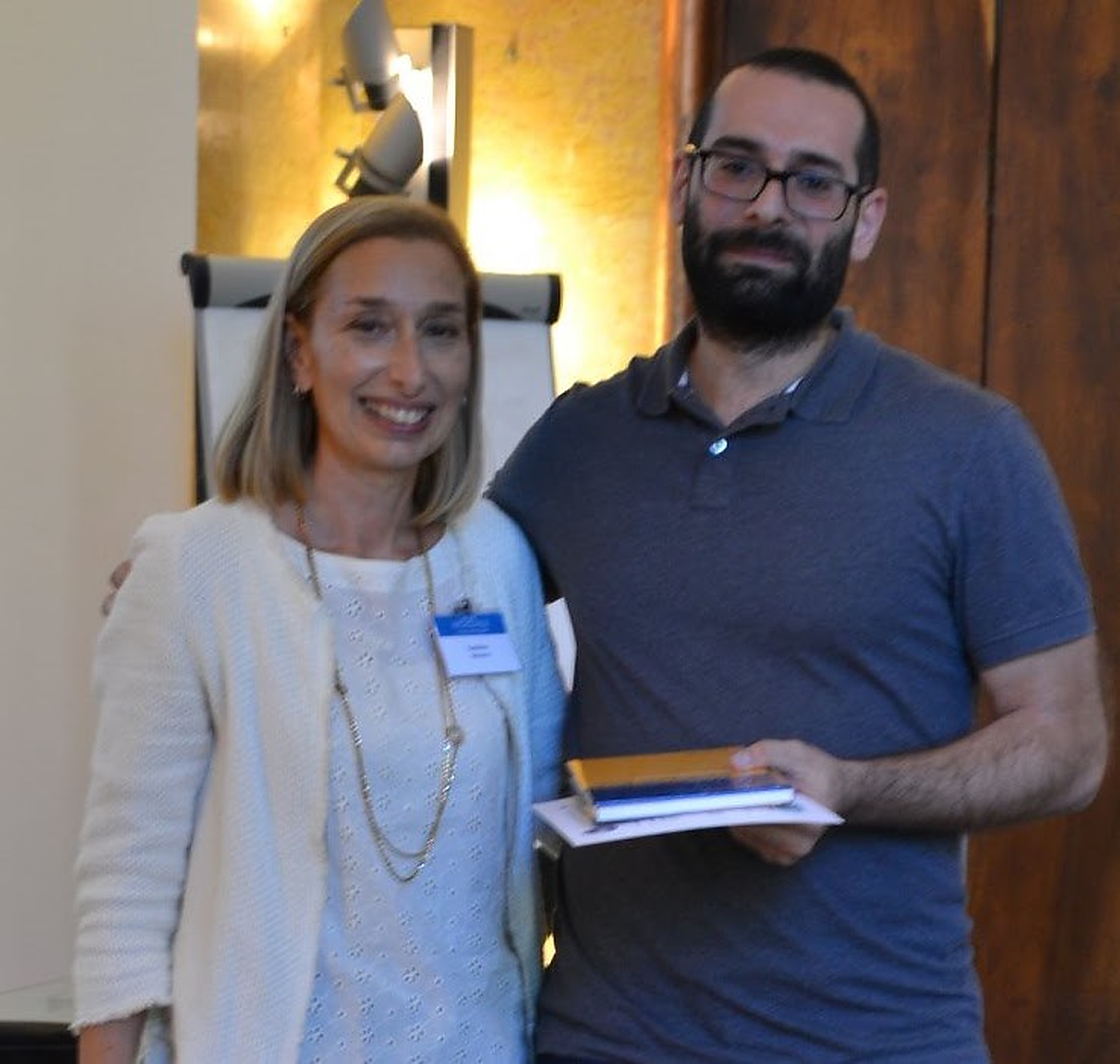
SFLA 2018 — a small award, a book by Lotfi Zadeh, and an unexpectedly important turning point.